Hi @sz
I’ll jump in off of the bench for @chris in the time before he provides his response.
The first thing to understand is the differences in Percent People Dissatisfied (PPD) among the different analyses. The PMVComfortCalculator that you have snapped an image of is the most basic, and most widely used thermal comfort model that represents a population’s mean vote (from a seven point thermal comfort survey) and satisfaction based on perception of comfort across the whole body. In otherwords, what percent of the population will feel uncomfortable given the ambient temperature, humidity, air speed, and radiant temperature. This differs from the draftComf and ankleComf because those are discrete, targeted thermal comfort models that maintain their own PPD thresholds. For example, the image below outlines the acceptable radiant temperature differences given non-uniform radiation field within an indoor environment, taken from ASHRAE 55-2013 Table H1. The acceptable limit for radiant asymmetry is 10% so if you draw a line across at 10%, you can determine acceptable differences in radiant temperature.
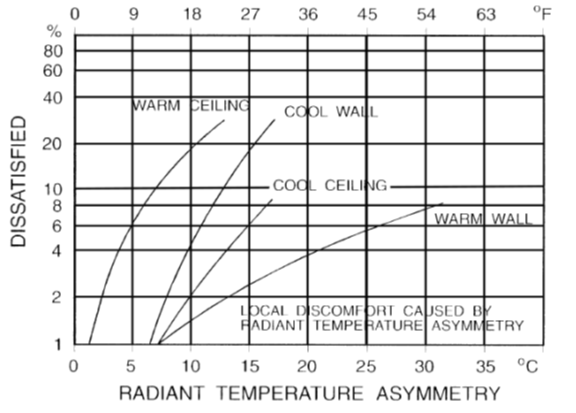
Radiant asymmetry, along with other types of unique comfort models, are covered in ASHRAE 55 and the draft and ankle discomforts are categorized as types of “local discomfort”, along with radiant asymmetry and stratification.
To answer your question, you may find this example script that @chris developed useful for your work. In this example, Chris takes the max value between the differences between the PMV-PPD and the local discomfort PPD to determine the worst case.
Hopefully this helps in the meantime!