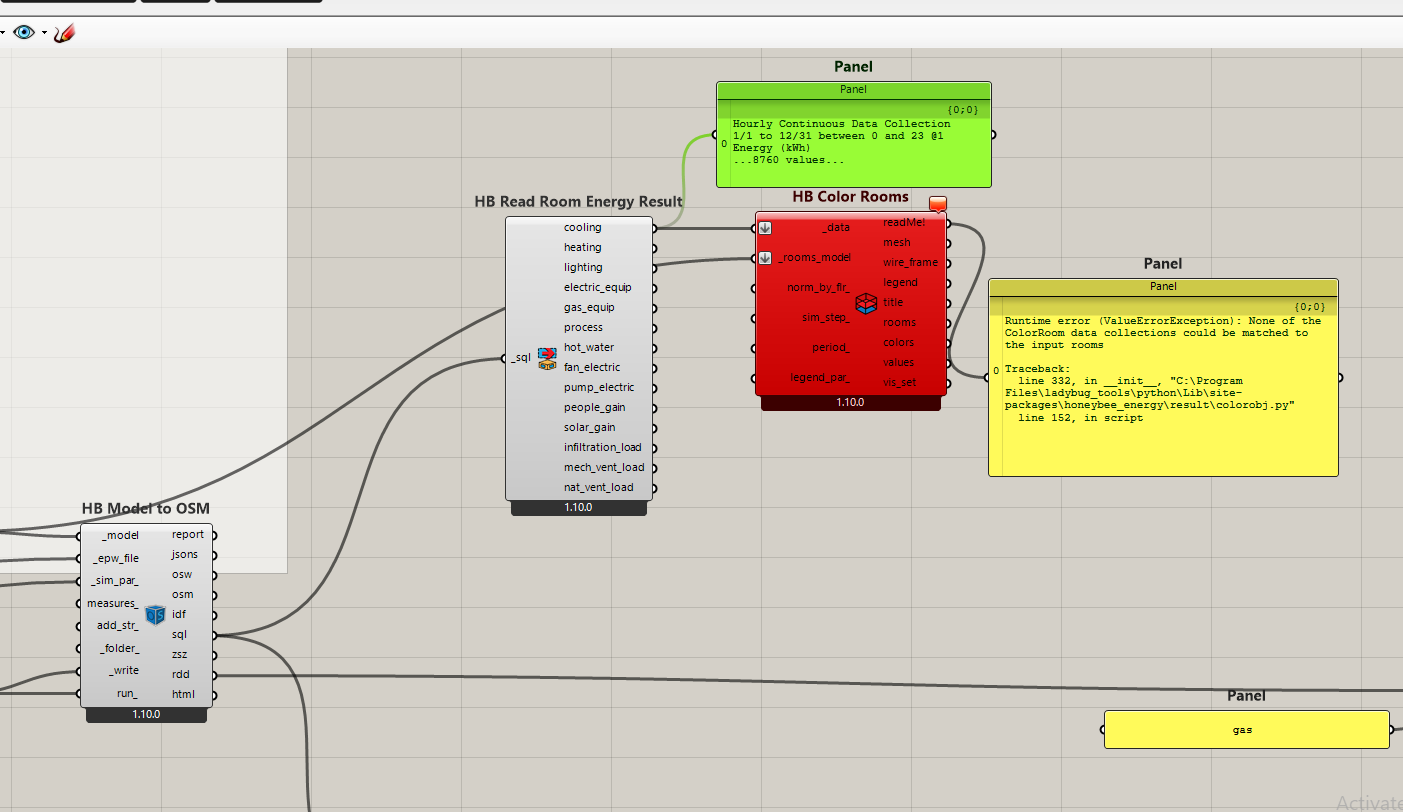
Is it, though? Did you save the simulation model to a Honeybee JSON file and then load up that model in the file that you are using to visualize results? Or, instead, did you re-run the Grasshopper script that creates the model, thereby generating an “equivalent” model that is actually a new instance?
The former will be match-able to your simulation results but the latter will usually not be unless you have managed to hard-set the unique IDs of all the model elements using the “HB Set Identifier” component.
Also note that, when you run the simulation with the “HB Model To OSM” component, you automatically get a .hbjson model JSON within the simulation folder. So you can always load that up and have it match with the sql results. Having the future “Lookup Folder” component return both the hbjson and the sql files seems useful.
Ohhh, Json, Json …
Indeed i was connecting the original model.
Now with the Json it works.
Though, i remember a different topic regarding the shading control that is not yet (well) implemented in the Json file. Right now the models that i create having shading controls can’t be imported with the LoadObjects component.
I’ll wait for that.
Thanks for reminding me about the Json @chris,
-A.
Thanks for reporting the issue with WindowConstrucitonShade, @AbrahamYezioro . There were a couple of bugs that I found in the case of schedules being applied to the object. They have all been fixed between the PRs below and I can now say confidently that the schedules for the WindowConstructionShade make it safely thought JSON serialization/re-serialization and they make it into the OSM/IDF.
I figured out where the problem is. The problem is with the data header. When I manually change the header, it works. So there is a bug in the HB Color Rooms.
the problem:
" Energy (kWh)
1/1 to 12/31 between 0 and 23 @1
System: OFFICE_SHOE_BOX_2418D589 CENTRAL AC COOLING COIL
type: Cooling Coil Electricity Energy "
Both the HB Color Rooms and HB Color Faces components require the Metadata from the Ladybug Data Collection to have a key-value pair of “Zone”, “Surface” or “System”.If you only need to bind a certain piece of data to any of the Rooms or Faces, then you can use the LB Apply Metadata component.this component can quickly add some custom key-value pairs to the Metadata.
The addition of this component precisely addresses this possible accidental situation.
However, this is merely a way to assist visualization through customized data. Therefore, it does not represent the most suitable visualization process for your specific case.
 -)
-)