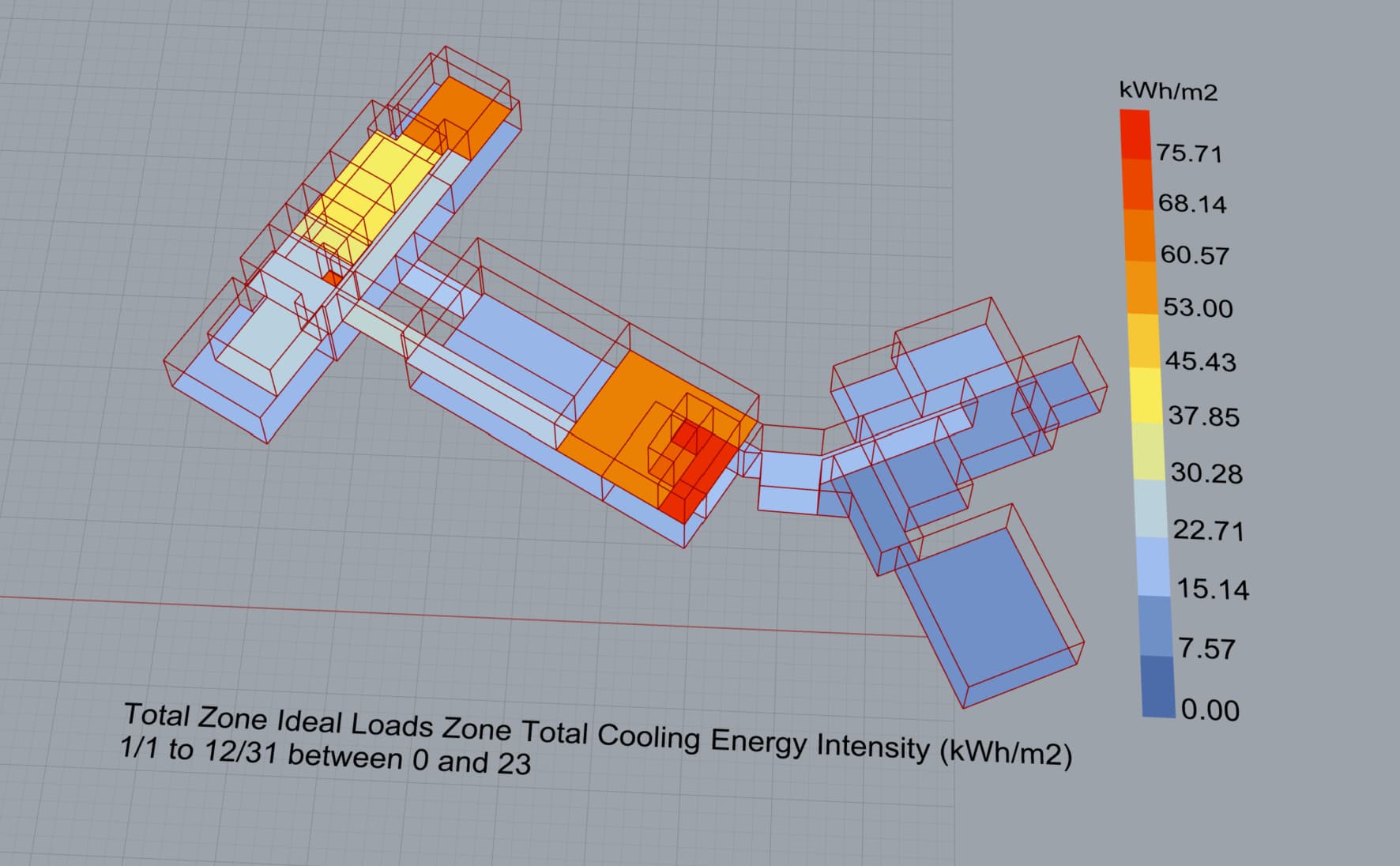
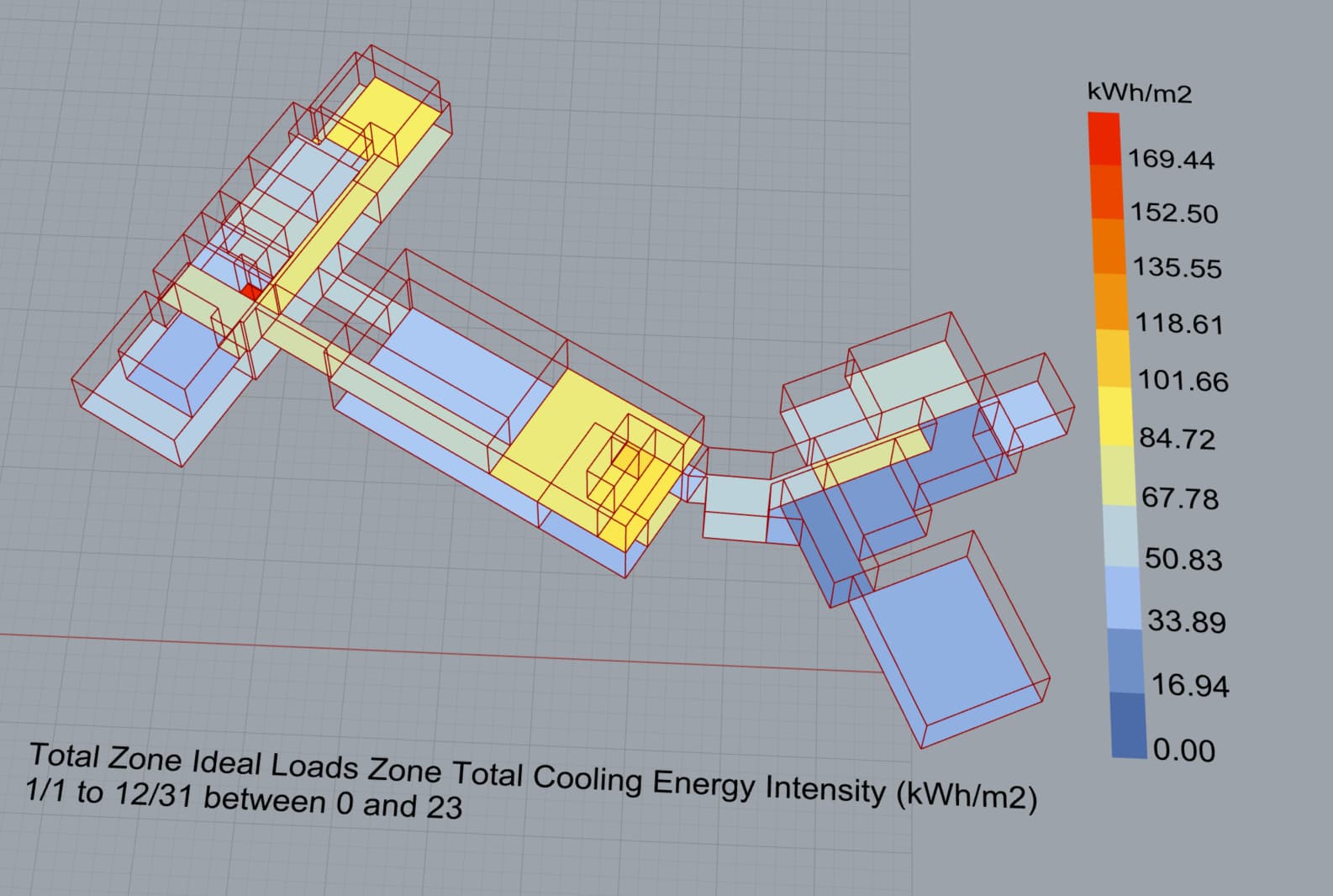
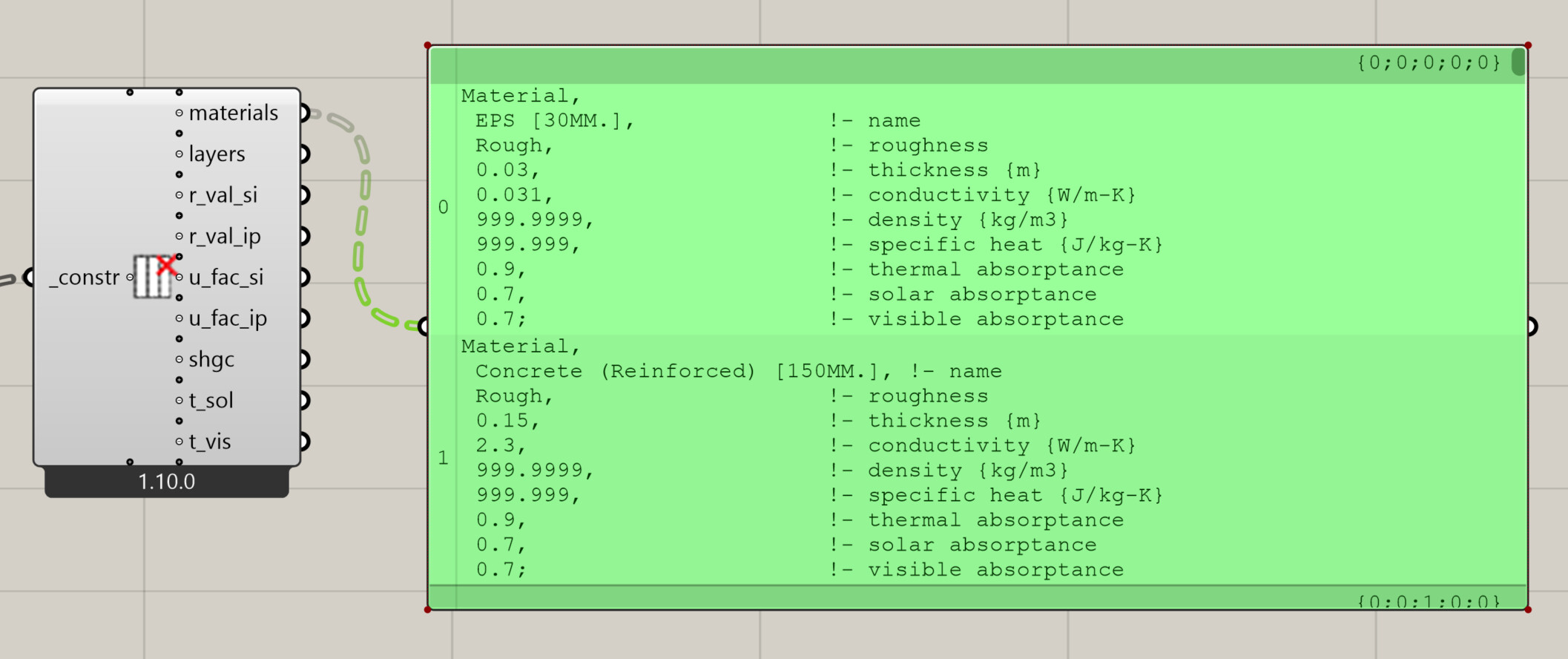
When I add 30mm of insulation to a ground-contact floor construction, my annual cooling demand approximately doubles. Heating demand responds as expected (decreases slightly). The change seems disproportionate for 30mm of insulation. Note: when viewing the script I have placeholder loads applied to this model and have removed it’s constructions as it was connected to my database. I also don’t have doors in this model but tested in one that did and the same issue persist.
I can’t check the file at the moment, but this increase in cooling loads is plausible.
You are roughly decreasing your U-value from 4 to 0.8 W/m2.K – this is not negligible. By adding insulation to the ground, you might be trapping heat gains (e.g., solar, people, appliances) inside the building. This is especially the case if you don’t use an appropriate ventilation strategy.
You might claim that adding insulation would reduce heat gain from the ground, as is usually the case for the envelope during hot summer days. However, assuming you didn’t change the ground temperature, EnergyPlus will consider a constant temperature of 18°C throughout the year. Therefore, the ground acts as a cool reservoir for your building during summer. When you add more insulation, the beneficial heat loss towards the ground is reduced, and cooling loads rise.
To test this, I would apply the same insulation test to the envelope and plot the heat balance. Also, you can try changing the monthly ground temperature using the add_str_ input in the simulation component. You can use the attached .ghx file to test that: ground_temp.gh (24.5 KB)
One final remark: be careful with your densities/specific heat capacities, they are not realistic and will change the transient behavior of the building.
[Edit: I completely missed Gustavo’s reply, which contains the gist of my explanation below.]
Without running one of the ground preprocessors (not yet available in Honeybee, I think), the ground coupling in EnergyPlus models is not very accurate: the ground immediately beneath your slab is treated as having a consistent year-round temperature, often around 65°F. If your slab is not modeled with insulation, this basically gives you a large, cool surface that provides quite a bit of unrealistic free cooling. In practice, there will be a temperature gradient in the earth that leads to a far smaller heat flow through the slab.
Since it is difficult to accurately model the ground heat coupling (a fundamentally 3D process), you may consider just treating the slab as adiabatic, with the understanding that you are not capturing the impact of ground coupling. That is not ideal, but it is probably not as inaccurate as modeling a slab without insulation.
Another option I have seen recommended is to model the ground temperature as 2°F cooler than the average monthly indoor temperature, or something like that (fuzzy memory, don’t quote me on that).
Sorry for the late reply, your message was very helpful. I ended up doing some testing and found the results were mostly plausible, aside from the consistent year-round ground temperatures.
I discovered a few minor issues with my setup which once fixed corrected the results slightly. Like you mentioned from what I can tell the floor insulation was primarily trapping the heat gains, although the unrealistic ground temperatures also appear to have played a role. Correcting the ground temperatures alongside these fixes seems to have produced much more accurate results.
I’ve now implemented your component into my script as well, so thank you again it’s much appreciated
In case it is helpful to use as an example, we used the Kiva ground-solver for a recent experiment doing Phius REVIVE style resiliency calculations which rely on accurate surface temps (and therefor accurate ground temps). My implementation here is super hack-ey since HB does not support Kiva surfaces natively. Its on the HBE issues list, but not supported just yet.
But if you take a look at the Grasshopper example file in the repo there, I think you can see and follow how we did it.
By using Kiva in your E+ simulations, you can get better predicted ground temps, and therefor better predicted ground heat-loss values.
For those interested, this paper compares different ground characterization approaches in EnergyPlus (e.g., Kiva, FCfactorMethod):
Gutiérrez González, Vicente, Germán Ramos Ruiz, and Carlos Fernández Bandera. 2022. “Ground Characterization of Building Energy Models.” Energy and Buildings 254 (January): 111565. https://doi.org/10.1016/j.enbuild.2021.111565.