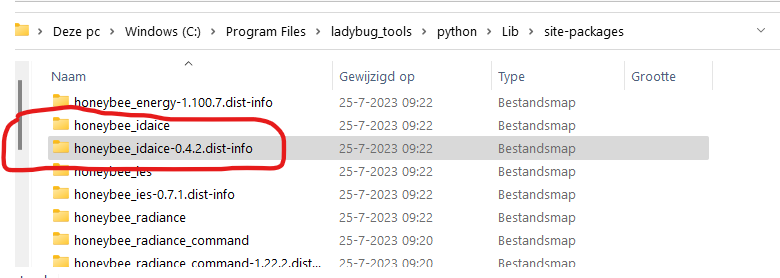
With my simple understanding of python I just tried to import this library (ghpython) but it somehow is not recognised by the ghpython component. Is there anywhere some information available on how I could achieve this?
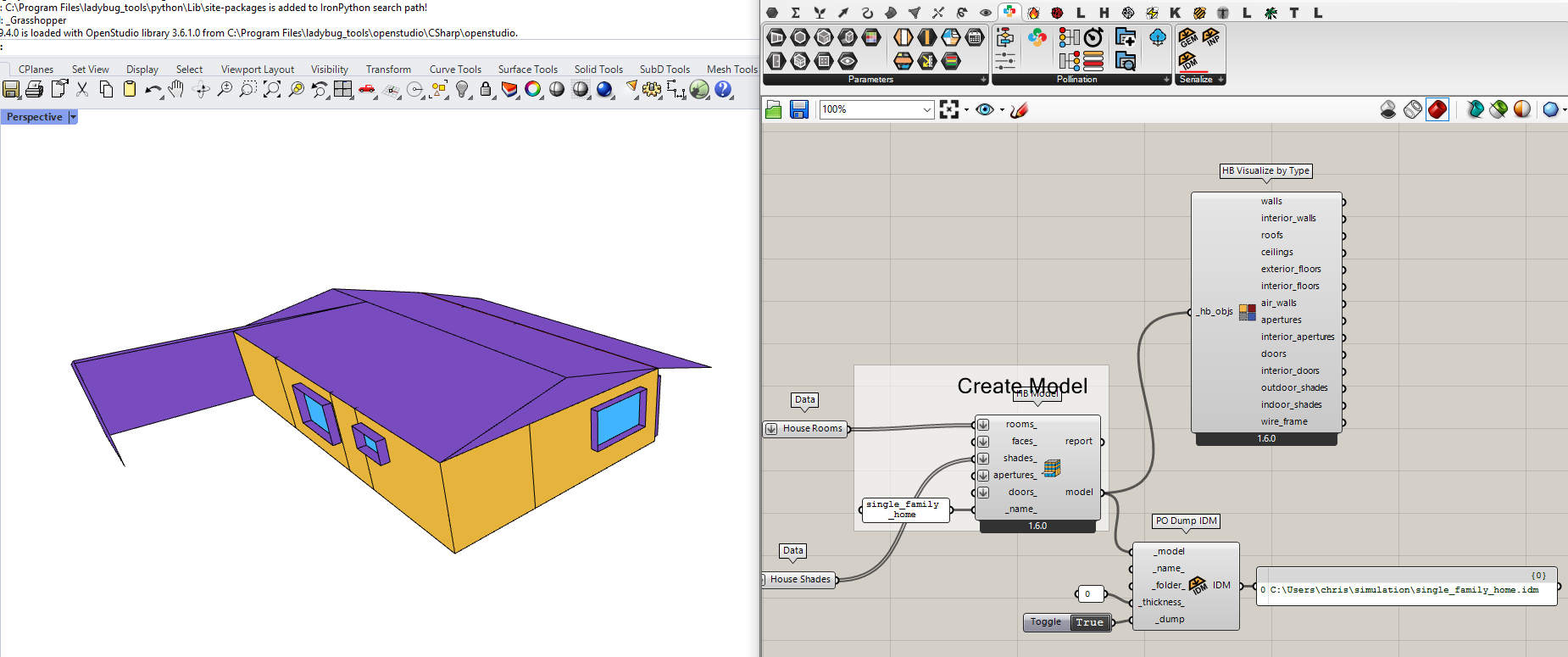
If you’re serious about using the LBT ecosystem to produce full-building IDA-ICE models, then I would really recommend using the Pollination Rhino Plugin or at least testing the free trial of it before you go down the route of trying to use the honeybee-idaice package yourself. When you install the Pollination Rhino Plugin, it will give you a component that can write any Honeybee Model to an IDM file like so:
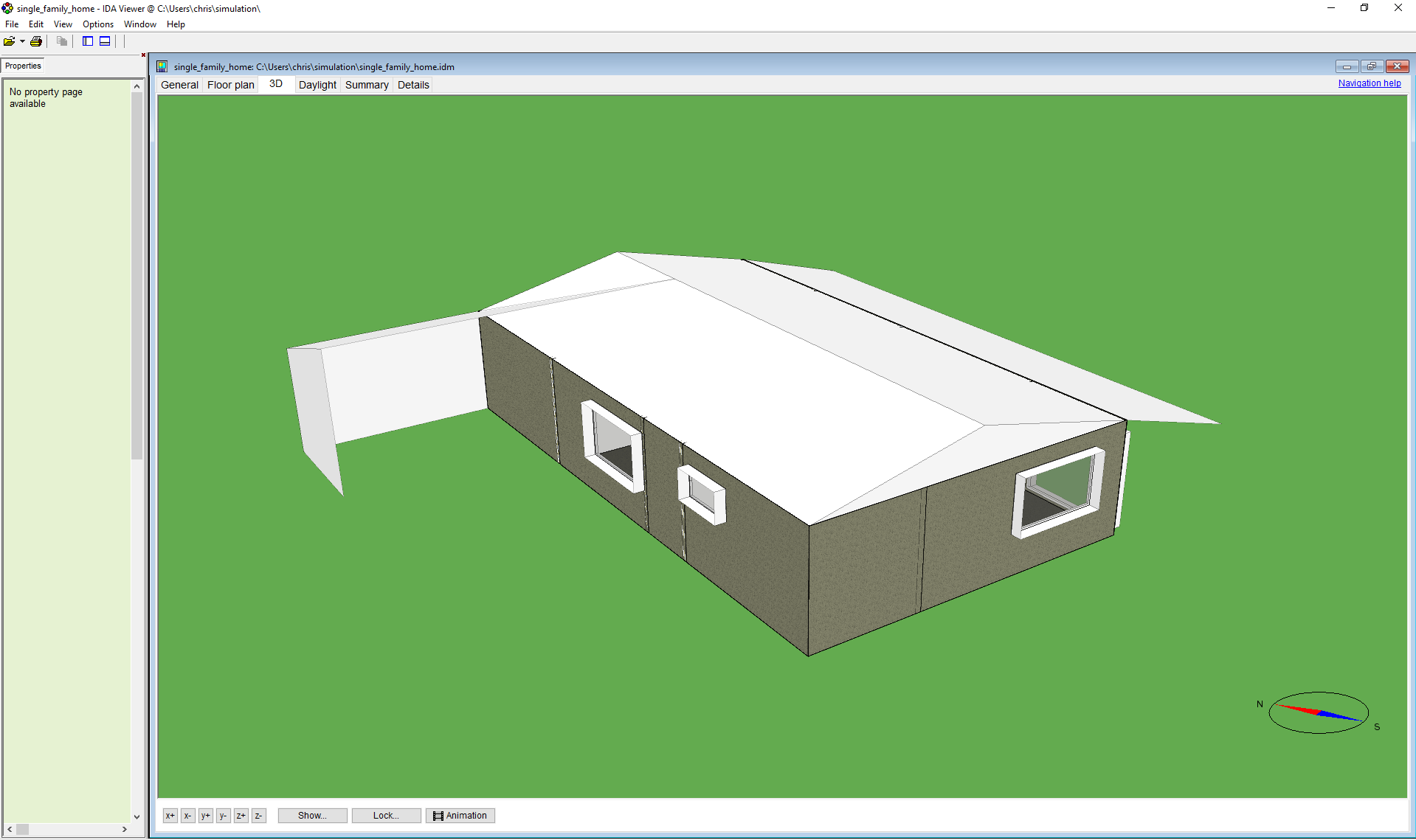
… and, if your Honeybee Model is valid and you have set the correct _thickness_ for the interior walls to be used in translation, it should open in IDA-ICE without issues:
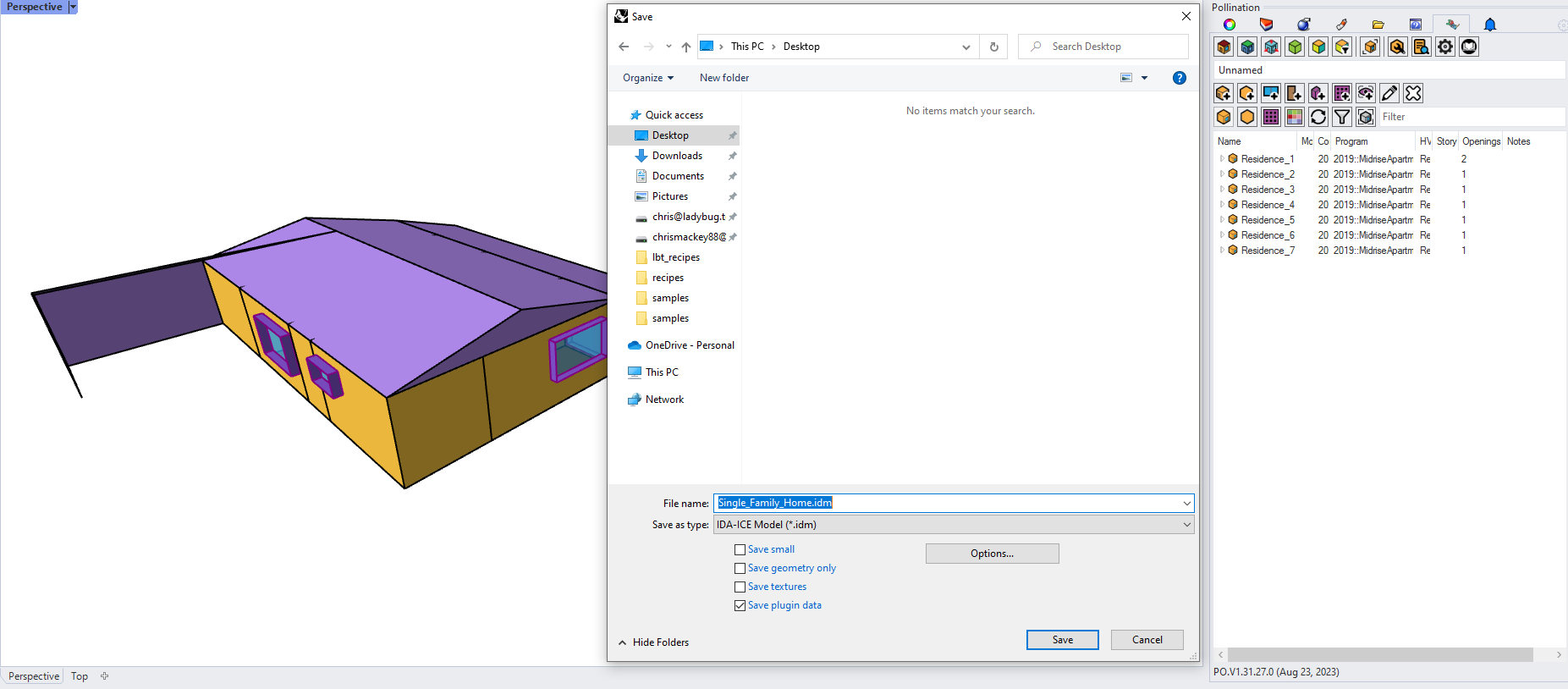
The Rhino plugin will also give you a “Save As IDM” option if your model is currently loaded in the Pollination Rhino plugin, which does the same thing as the component:
So that is what I would recommend if you want to use this in an office where you’re constructing full building energy models on a regular basis and you don’t want to spend hours going back and forth trying to get the model to translate to IDA-ICE correctly. The Rhino Plugin gives you a really good interface for validating your models along with a range of commands for actually fixing these validation issues. It’s also worth noting that, if your model is passing validation in the Pollination Rhino plugin but is translating to IDA-ICE with warnings or errors, we’re committed to fixing the translator so that you do not get the warnings or errors. So trust me that the cost of the Rhino plugin is worth it if you’re being paid to make an energy model and your time is valuable.
Granted, we also understand that you may just be constructing simple models as a researcher, like the single family home I showed above, where getting a valid model is less of a challenge and you have a lot more time on your hands. Or maybe you’re an IDA-ICE expert who wants to tweak things in the translation process. It’s for these reasons that the honeybee-idaice package is open source but just bear in mind that it only does the translation correctly when the input model is valid and it can take a lot of time to get to that point. If you’re going down this route of working with the honeybee-idaice package, you won’t be able to import it directly into GHPython because it has C dependencies and GHPython uses IronPython, which is based on C# rather than C. So you’ll have to interact with the package via CLI if you’re using GHPython.
Thank you @chris for the information.
I will try the pollination plugin.
Really nice you developed the export to ida ice workflow.
It will be useful for us.
Validating the model is no issue for us.
Inspired by Honeybee we are now working from BEM to BIM instead of from BIM to BEM.
BIM models tend to have to much data which you really do not need.
Hi @Erikbeeren! Let me know how it goes and if you have any questions for us. We have very limited knowledge when it comes to IDA-ICE but the feedback who far has been very positive. Will be great to get your feedback and better understand your needs.
i am trying to convert a simple box from honeybee .hbjson to .idm, but i am having trouble. The python script using model_to_idm function works but the idm cannot be imported in IDA ICE. I wonder if there is a simple tutorial explaining the workflow with an example files.
We will need this functionality for research project therefore it is unfortunately not an option to bui the pollination rhino plug in.
If you need a reliable way to convert your Honeybee models into an IDM format, I would recommend using the Pollination Rhino Plugin, which comes with a PO Dump IDM component that can be used to reliably export Honeybee models from Grasshopper into IDM files. And, most importantly, Pollination comes with a guarantee that the IDM will import into IDAICE without errors or warnings as long as it passes validation with the HB Validate Model component. If there is an error given by IDAICE for a valid honeybee model, then it’s a bug. You let us know and we will fix it or we will give you your money back. Which brings up the point that Pollination is a paid product but what you are paying for is the reliability of the exporter and the ease of use.
If you are the type of person who does not have funds to purchase Pollination but you have a lot of time on your hands to learn python and write your own scripts with the honeybee-idaice Python SDK, then I can point you to the resources to get you started here. But this is one of those things that you either pay for the ease of use as a Pollination customer or you pay with your time learning core Python libraries as an open source Ladybug Tools community member.
That is, unless you are a student, in which case you can get the Pollination plugin for 10% of the list price (90% discount).
Thank you very much @chris for your answer and the amazing work you and your team are doing with the ladybug tools!
I will send a message to get an offer for the pollination plug in and see if we can purchase it. In the meantime i would be happy to explore also the honeybee-idaice Python SDK. If there are resurces available i would be very glad to have a look at them.
Thank you very much again for your support.
Best Regards
Mara