Hi everyone,
I am currently trying to run an Annual Daylight (sDA) simulation for a building that features a BIPV (Building-Integrated Photovoltaics) curtain wall.
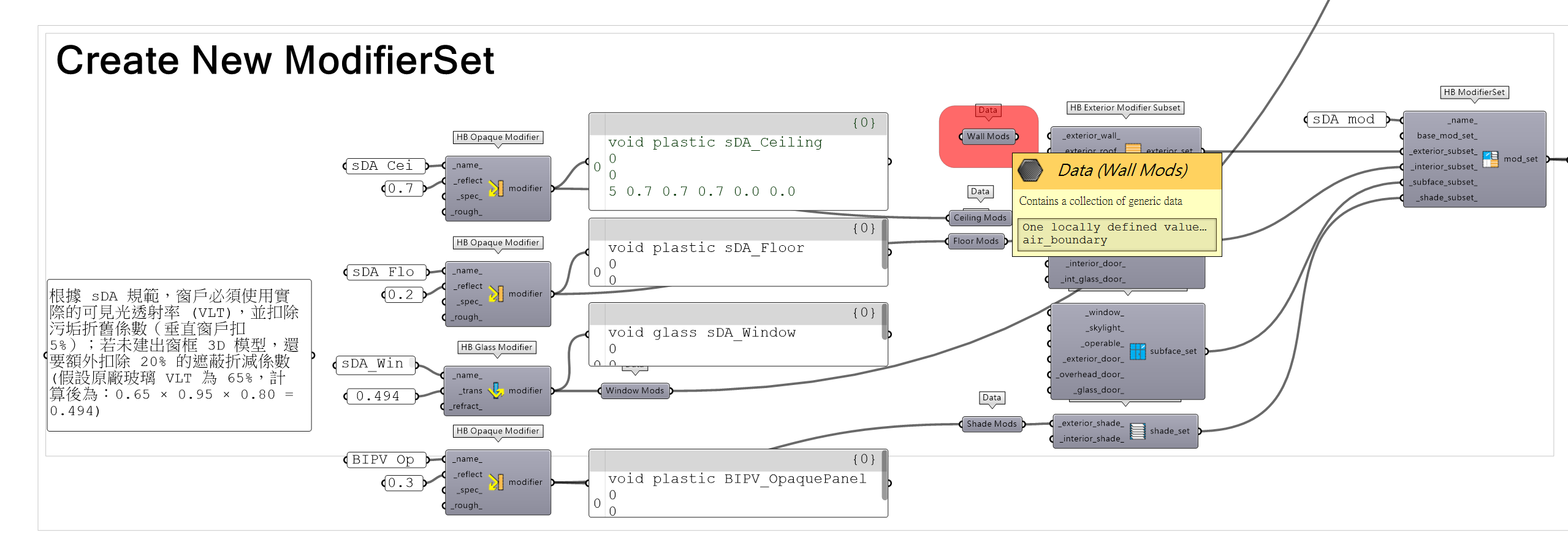
Since the exterior facade consists entirely of opaque solar panels and transparent glass, there isn’t a traditional solid exterior wall. To model this, I initially set the exterior Wall surface type/modifier to air_boundary and modeled all the opaque BIPV panels as HB Shade objects covering the facade.
However, the recipe failed to run, and I received the following error at the PrepareMultiphase step: oconv -f -r 32768 model/scene/envelope.mat model/scene/envelope.rad model/scene/shades.mat model/scene/shades.rad model/aperture/aperture.mat model/aperture/aperture.rad > octree/default.oct
I suspect this is because the Two-Phase/Multi-Phase daylight coefficient recipe strictly requires at least one actual HB Aperture to build the daylight matrices, and replacing the host wall with an air_boundary and shades removes the apertures from the calculation.
My questions are:
- What is the recommended workflow or best practice to model a curtain wall made entirely of opaque panels and transparent windows without triggering this error?* If I model them as standard walls and apertures, how should I handle the material modifiers so that the opaque BIPV panels act correctly on the outside, while still maintaining the standard 50% interior wall reflectance required by sDA (IES LM-83-12)?
Any advice or workarounds would be greatly appreciated. Thank you in advance!
modified question.gh (942.9 KB)