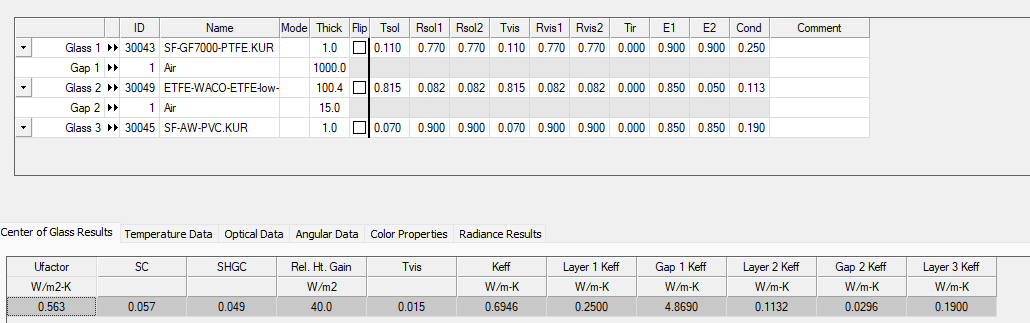
I’m importing an IDF file which I’ve exported from LBNL window and saved in C:\Users\joe.Roberts\AppData\Roaming\ladybug_tools\standards\constructions. According to LBNL window, the SHGC is 4.9%, but when I check the construction SHGC in Honeybee I get 3%. This seems more than just a rounding error. I’ve attached my idf.
I know it probably feels like it’s a big difference when the SHGC is so low but a difference of 1-2% in SHGC between WINDOW and Ladybug Tools is pretty normal and not an indication that the data was transferred incorrectly from WINDOW to Ladybug Tools. It results from the fact that WINDOW has a few different models for accounting for the convection in the air gaps in the IGU while we only have one model implemented in Ladybug Tools, which is relatively simple and designed to give quick estimates of U-Value, SHGC and convective heat transfer across the gap.
The calculation of convective heat transfer in IGU gaps can get pretty complex because you get more convective heat transfer the greater the temperature difference is across the gap. But you cannot really know the steady state temperature difference across the gap without knowing the thermal resistance of the gap. So WIDNOW has some advanced routines for solving this type of differential equation and they are more accurate at representing steady state NFRC test conditions than what we do in the Ladybug Tools source code.
But the more important thing for the accuracy of your simulations is that all of the detailed data about the layers of glazing and gasses in the gap is imported to Ladybug Tools and then sent to to your EnergyPlus simulations. So E+ can accurately model the dynamic change that happens in the thermal resistance of the IGU as the temperature difference across it changes with each timestep of the simulation.