Hi,
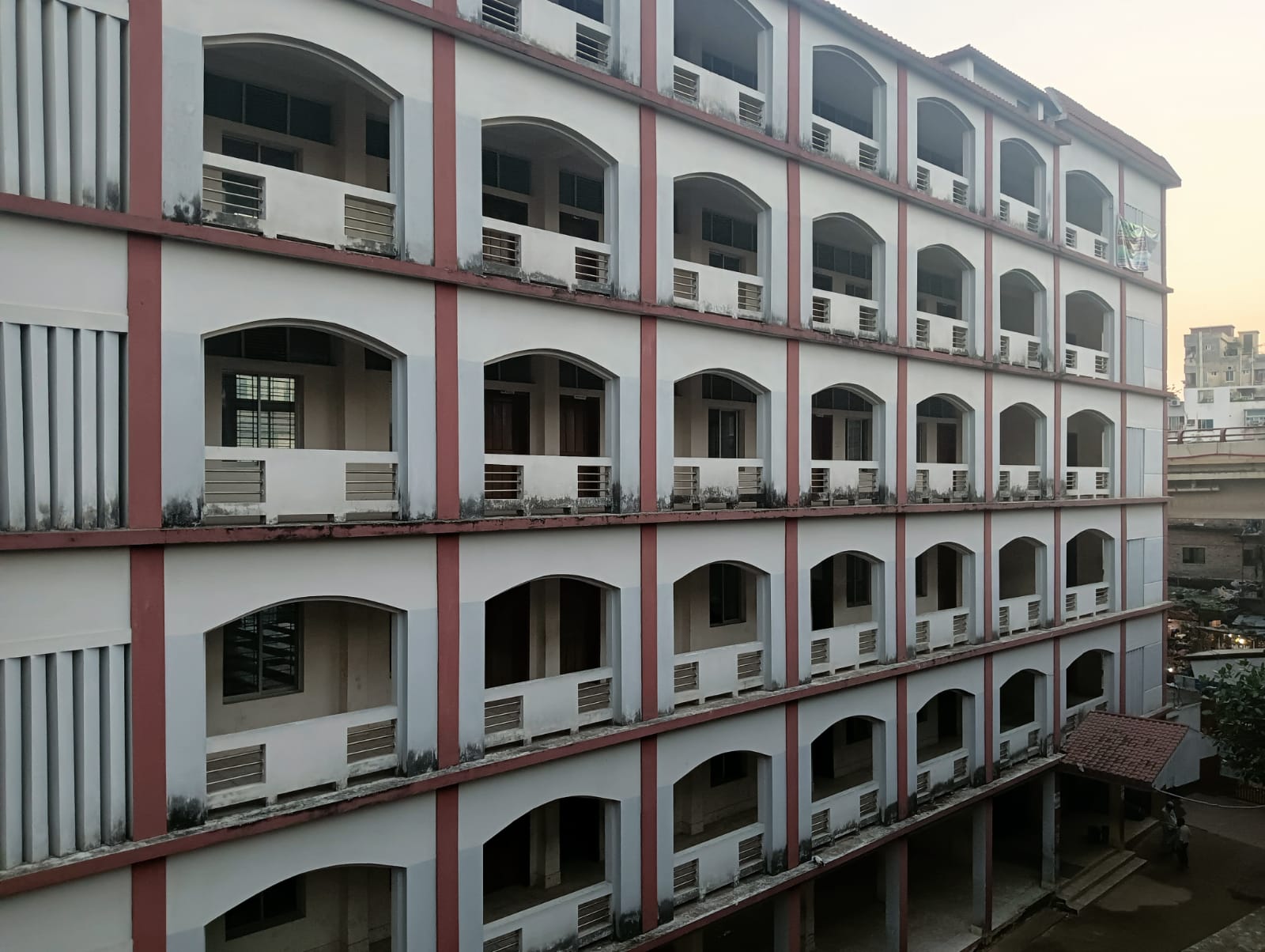
I am trying to model a school building corridor in honeybee. However, I am not sure how to model the single-loaded semi-outdoor corridor with these void apertures to get accurate results. As the zone must be a closed volume, which will be the best way to model these non-glazed apertures?
Hi,@Srijon
Regarding this issue, your first choice is to model all these non-closed areas as Shades and use them as the context of the Model.
Since you did not disclose your specific application scenario, however, in my practice, this method has been fully applicable in both Radiance and Energy scenarios.
best
Zhengrong
Thank you very much, @ZhengrongTao , for your kind response.
I have a follow-up question: why is it necessary to include these corridors as context as well? Would modeling them only as a shading system not be sufficient? I would appreciate it if you could clarify the reason for treating them as context in addition to shading.
hi, @Srijon
I think you are already aware of some limitations of HB Room. These limitations are mainly due to the modeling requirements related to HB-Energy. As I haven’t had the time to assist you in searching through some documents yet, usually in the Energy application, we use a complete closed model (such as Room or Zone) as the basic unit to calculate the building’s thermal balance. And for those areas that are completely mixed with air, which is the part you are concerned about - the corridor section - they are not modeled as part of the heat balance calculation because the heat indicators in those areas are entirely dependent on the outdoor environment.
However, the geometries of these areas still have an impact on sunlight and solar radiation because they are all opaque entities. Therefore, it is necessary to model them as Shades.
The suggestion I made earlier regarding using Shades as the Context of the Model is mainly about the issue of object ownership. Because these Shades that are created can exist independently and not be affiliated with any Room, Face or Subface. Regarding this, you can refer to the Honeybee-Schema Wiki. I believe this document will be helpful for you to understand the Honeybee Model.
@ZhengrongTao Thank you again for your time and for the detailed clarification. I now clearly understand the concept of the closed model zone.
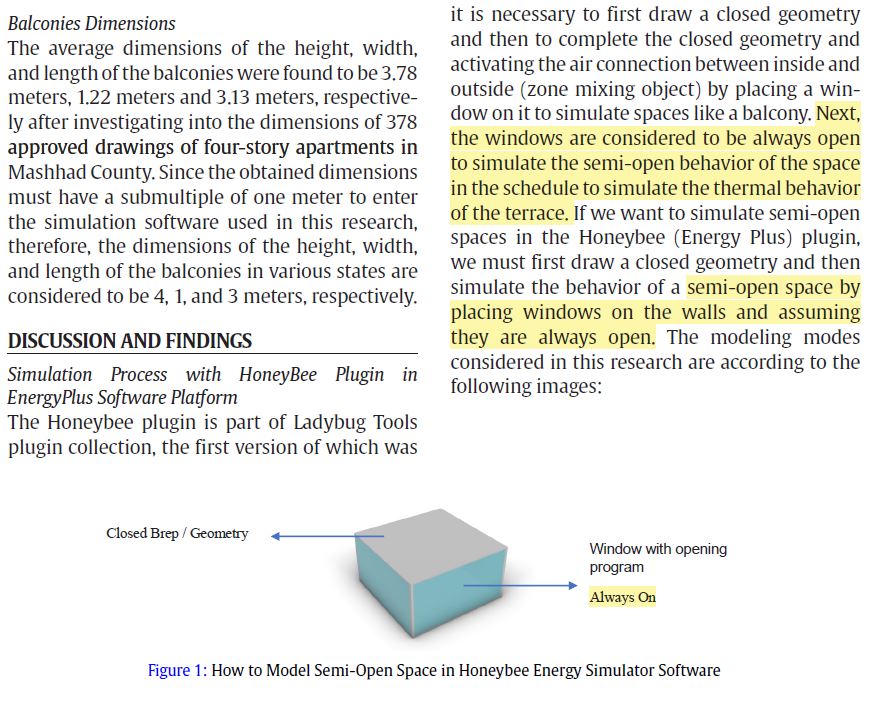
However, I came across another journal reference in which the semi-outdoor space was modeled as a closed space, but with a custom window schedule where the windows remained open at all times. Since there is human movement in the area and a dedicated Honeybee building program can also be assigned for a school corridor, I am wondering which approach would be more appropriate in this case.
Hi,@Srijon
If you are not very clear about what your calculation objective is, then I do not recommend using this method. Although in some cases, this method can be used to simulate a controlled semi-open area.
However, in the insulation and heat preservation design requirements for the building envelope structures in the vast majority of regions, the boundary between the non-sealed areas and the sealed areas will be designed according to the requirements of the outdoor side, such as the exterior walls, roofs, and suspended floor slabs. That is to say, these protective structures are designed in such a way that they need to be truly associated with the convection of outdoor air and solar radiation. If you create the two regions separately, and one of them uses the method you employed for the search, the boundary conditions between the two regions are not necessarily accurate, and the algorithms for heat calculation are not necessarily applicable (especially the default air convection algorithm), and the results may not be more precise than the process I suggested.
Similarly, this semi-open corridor enables the Program to be less than perfectly accurate in its simulation, although it may seem comprehensive in terms of process, it is completely meaningless because these heat sources do not require any equipment to handle, and they will be diluted like a bottle of cola being poured into the ocean through natural convection, thus unable to affect any closed spaces dominated by humans, which are the ones that should focus on thermal balance.
If you want to reflect certain aspects of total energy consumption, such as outdoor lighting, you can refer to this post and implement it using the SDK (this issue may arise in the practice of Ladybug Tools and LEED).
 However, I need to point out that all these suggestions are directly based on my own experience. If other users have better suggestions, you can also refer to them. Maybe I might be wrong somewhere.
@ZhengrongTao Thank you so much. I am modelling the corridors as shading devices. Your solution seems more accurate considering convective cooling, air mixture, and focusing on the classroom thermal balance. Thank you once again.