I think this is due to the crude nature of the simple window material component, and the way EnergyPlus (EP) attempts to disaggregate the U-value and SHGC into detailed material parameters for simulation. So even when you think you’re varying one parameter (i.e. U-value), you’re actually also varying parameters like solar transmittance since EP will use the former to calculate the latter. This is a reasonable assumption on EP’s part since those two values are physically related, but can be confusing since we (incorrectly) expect something like U-value to change one material parameter, and thus impact cooling load linearly.
Here’s a comparison between the cooling loads of a simple window model (which is converted by EP into a single-layer detailed window) and a single-pane detailed window model, for the same U-value increments you’re studying. You can see the same non-linearity occuring in the simple model but not in the detailed model:
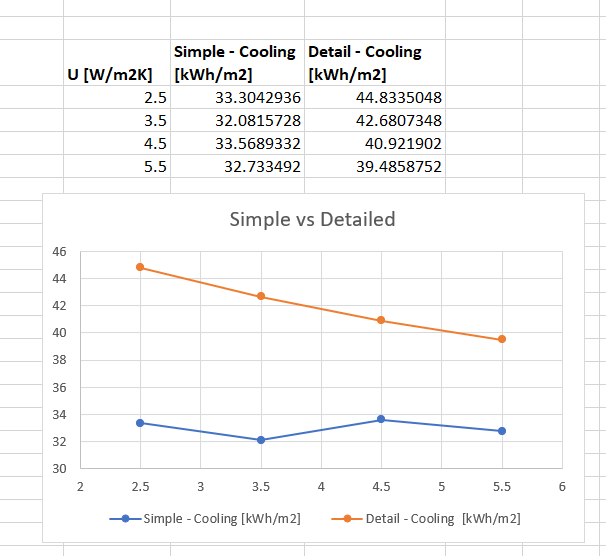
So try reproducing your study with a detailed window construction and I think you should see the non-linearity go away.