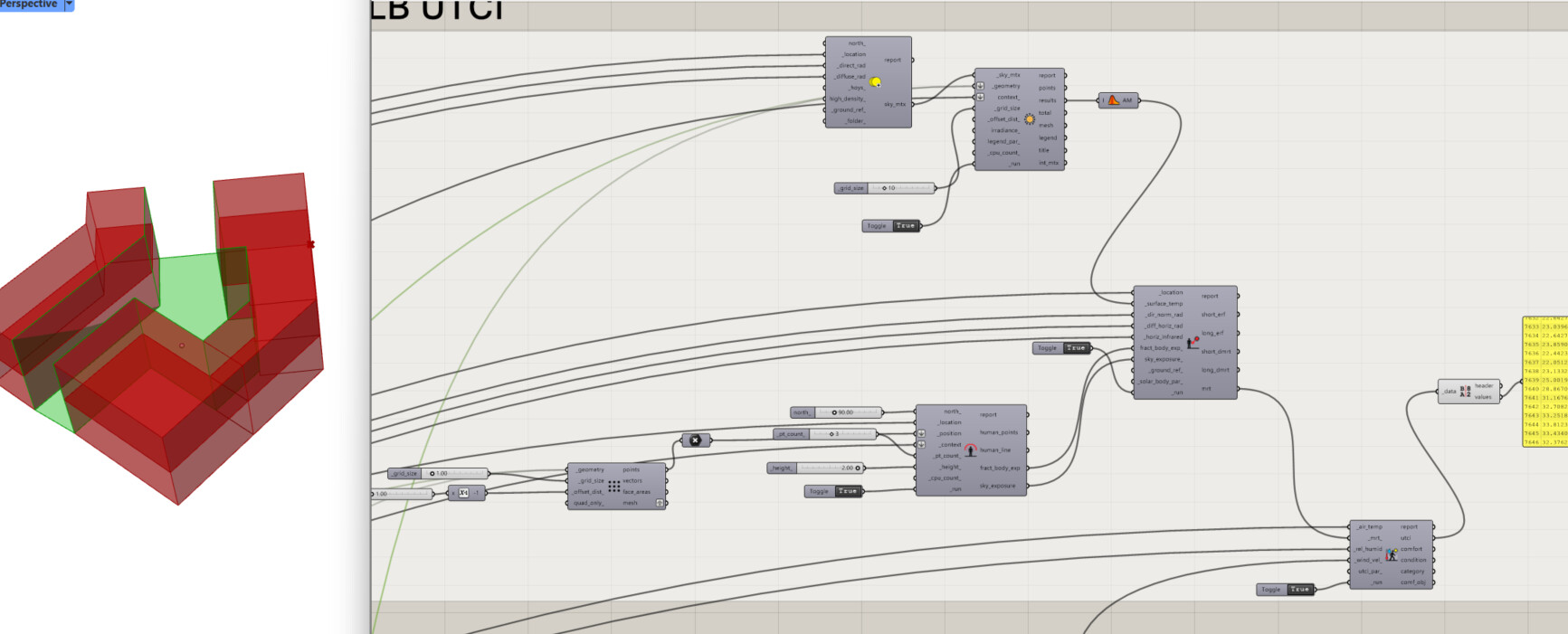
I was wondering if anyone before has used Eddy 3D as an input to simulate outdoor thermal comfort? I am working on a GH setup that should optimize courtyard dimensions to accelerate wind and increase shading to improve thermal comfort for outdoor and indoor. I am using:
LB incident radiation (geometry: courtyard walls and floor, context: the whole house) to surface temperatures.
-LB human to Sky relation (with LB generate point grid connected to courtyard walls and floor)
and Eddy 3D where I am using the wind factor annual as an input to UTCI wind velocity.
Hey,
You can use UTCI comfort map component to calculate the solar radiation and input the air speeds via submitting a csv file. You can find examples of the wind inputs on this forum.
Cheers
Thanks Dimtry, I know we can do that via using an excel sheet or a direct input from epw file. But here in this case, I am testing different courtyard dimensions impact on wind velocity/ air speed through Eddy 3D, would that be a valid approach?
But the question from @noura2586 may not be answered through that approach.
I recommend the following articles. While the first one discusses the gap in data exchange between BEM and CFD-based Urban Microclimate Modeling (UMM) tools, the second one outlines a way forward to input near-surface resolution microclimate data from CFD-based UMM in BEM (bypassing EPW).
The two-way data exchange between CFD-based UMM and BEM tools (called coupling) is crucial to account both building indoor and outdoor impacts simultaneously. Due to high computational costs of CFD-based UMM tools, it is challenging to perform.
Thank you, @Naga, for your input—it is very much appreciated, especially given the excellent work you have shared in previous threads. Both papers are highly valuable learning resources. However, I realized that developing a single workflow that simultaneously accounts for both indoor and outdoor thermal comfort may be unnecessarily complex. I have therefore decided to split the workflow into two distinct phases, each targeting a specific thermal comfort objective.
My current approach for outdoor thermal comfort and courtyard geometry minimizationn involves running two successive optimization rounds:
Wind-driven comfort optimization
The first round focuses on enhancing wind velocities for three different wind directions by optimizing courtyard opening configurations. This follows a methodology similar to that presented in *“Research on the wind environment in an enclosed courtyard: Effect of the opening position, size, and wind angle.”
Adjusted wind velocities within the courtyard probe points are obtained from Eddy3D simulations and fed into an optimization component (Wallacei). The resulting geometries then undergo a second optimization cycle, during which a full Honeybee (HB) model is employed to derive shortwave radiation. This is where the outdoor surface temperatures are passed first to the SVF component, and then to the outdoor MRT calculation.
I will attach my file tomorrow as currently the system I work on is not available. I would appreciate your thoughts on this?