I have downloaded Ladybug Tools 1.4 recently, and i want to create a split system air conditioner with no ventilation in honeybee. However i can’t find the corresponding templates in HeatCool HVAC Templates, should i choose residential heat pump instead of it?
For a case like this, I would recommend using the VRF system type under the HeatCool HVAC Templates. Admittedly, VRF systems tend to be a little more sophisticated in their controls when compared with residential mini-split systems (if that’s what you mean by “split system air conditioner”). But the VRF HVAC templates have separate outdoor and indoor units just like residential mini-split systems and many people refer to VRFs as “split systems”. So I think you can trust that the results you get with VRFs will be close to those from the actual HVAC system type you are imagining here.
Thanks for your kind reply, I think VRF systems are very close to split AC systems and can be used in some cases. However, there are still some questions, for example, VRF is usually one outdoor unit connected to several indoor units, so the power rating of the outdoor unit is higher than traditional split AC system, will it affect the accuracy when modeling the energy consumption of only a single room?
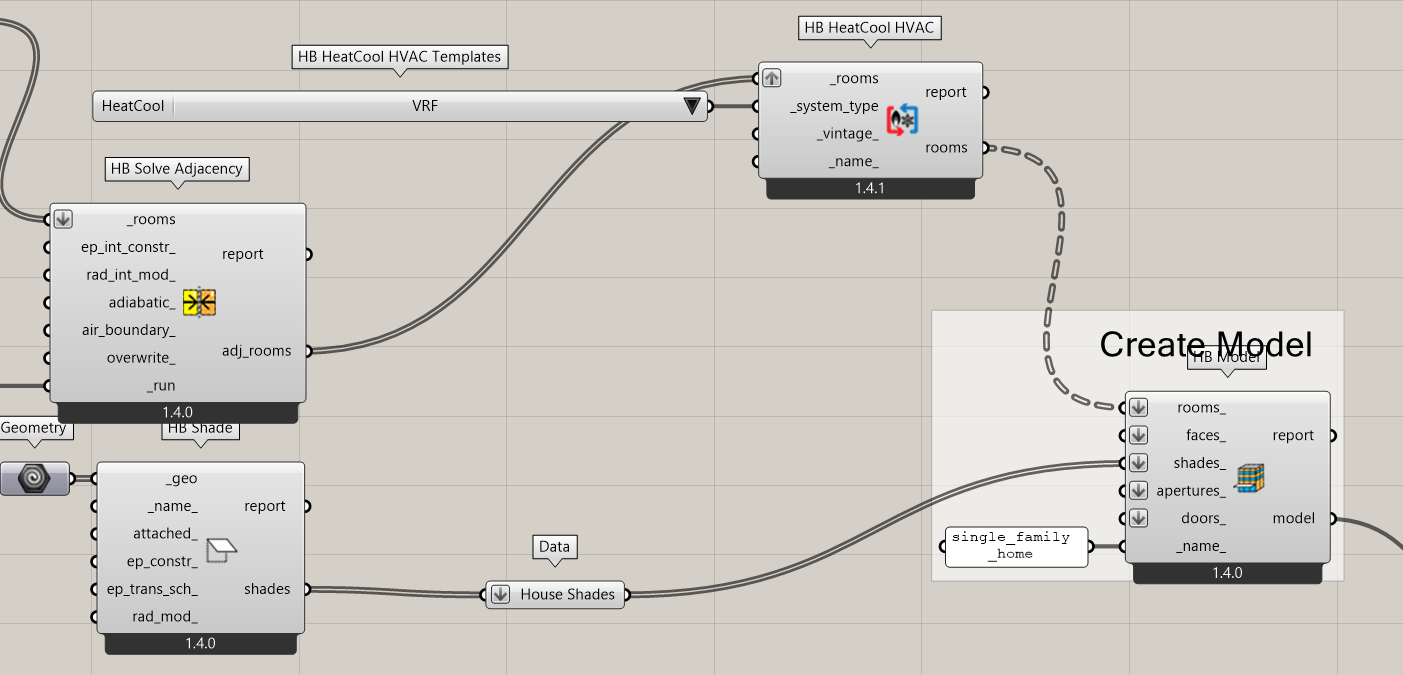
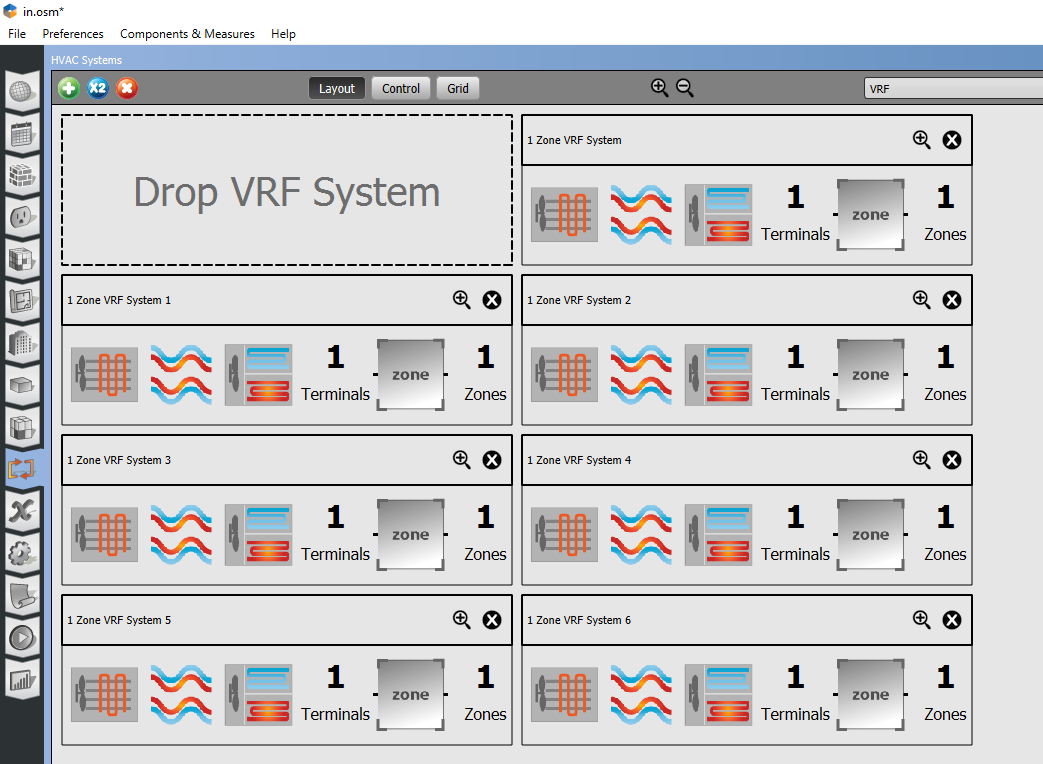
I don’t know if I understand your question correctly but you can ensure that each Room gets a separate outdoor unit by grafting the input to the “HB HeatCool HVAC” component like so:
There is still a discrepancy between reality and modeling regardless of whether the VRF or split AC is chosen because the efficiency of the HVAC does not match that of the actual AC. How can I overcome the limit?
If you’re doing a production-quality energy model to forecast utility bills and you know the actual efficiencies of your specific system, then you can always edit the VRF properties of the OSM in the OpenStudio Application to reflect this (or use any of the other HVAC-editing workflows that are mentioned here).
But, if you’re just trying to get a sense of how the energy use of a split system compares to other systems in order to help with the decision-making process, I think it’s perfectly fine to use the VRF template for this purpose.
thank you for your kind reply and i’m sorry to reply so late, i have noticed some similar questions within that an example of using GHpython component to edit the HVAC templates was shown. i’ll study that and learn how to customize my HVAC systems. Thank you very much!
Does PTAC with no heat do the same purpose? particularly it says inside OS that PTAC works with DX cooling and some sorts of heating (HW, Gas, or Elec). So, does that mean a PTAC with no heat works pretty similar to a mini-split which mainly depends on refregirant DX?
Using a PTAC (or a PTHP if the minisplit does heating) is a decent way to model a minisplit system as long as the real system you are trying to model has only one zone with a single thermostat. A lot of single family homes use one thermostat for the whole hose (or maybe one thermostat per each floor of the house) so, in these cases, modeling all rooms as part of the same zone and using a PTAC can be fine.
However, if you have separate thermostat controls for each terminal unit all connected to a central outdoor compressor unit, the VRF system is going to be the better way to model these types of systems. This way, you capture the effect of some rooms having different thermostat temperatures than others and the overall impact this has on the central compressor unit.
Hi Chris, I am facing a similar issue. I am currently modeling a typical residential building in a cold-climate city in northern China, where the heating system is district heating with hot-water radiant floors in winter, while in summer the cooling is provided by standard split air conditioners.
For the cooling side, I am wondering if there is any more accurate or recommended system available in Honeybee or Ironbug to represent this configuration at present.
Or would you suggest using PTAC or a VRF terminal unit as an approximation for the split AC system?
Ironbug does not have a ready-made system template for floor heating split-type air conditioners (heat pumps) with District Heating sources. However, if you refer to several templates, such as HVAC Template Simple’s sys13 + sys01 or sys02, replace the existing DOAS branch of sys13 with the air conditioner or heat pump. If your split air conditioner uses electric heating, then you should use PTAC.